
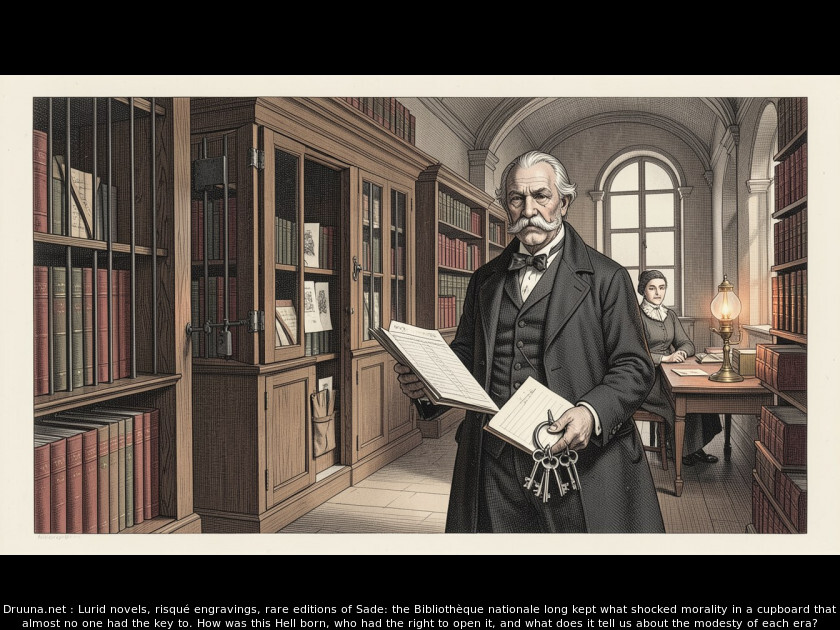
What do we mean when we say "Hell"?
The word brings a smile, but it describes the situation very well: in library vocabulary, Hell refers to the part of the collection that is kept closed and that ordinary readers never see. It contains books that are thought to be harmful to those who read them.
At the National Library, it is primarily morality that decides. There have been instances where a political or religious work slipped into the lot, but it is not for them that the door was locked. What was hidden was anything that offended decency, and this could be a text as well as an image.
The result resembles a cabinet of curiosities for adults. One finds libertine novels and risqué songs, engravings and drawings, photographs that are among the oldest of the genre, and pieces that come from Japan. In terms of authors, it ranges from Sade to the most notorious writers of the 20th century.
In 1849, Naudet describes the place as a sort of hideout that only the curators have the means to open. What is inside is, in his eyes, as bad as it is expensive. He even compares it to the secret museum of Naples, where what was not meant for all eyes was similarly hidden.
Before Hell: the novel kept at a distance
Setting certain books aside is nothing new in the 19th century. As early as 1702, a librarian named Nicolas Clément invented a classification system that reveals a lot about the mentalities of his time. Each letter designates a field, and a small sign placed above the letter is enough to set apart what seems less respectable.
Take the letter Y. When it stands alone, it designates poetry. When it carries its exponent, it welcomes the novel and everything that serves to entertain. It must be said that the novel has a bad reputation at the time: the Jesuits condemn it and the Jansenists end up doing the same around 1740.
For some specialists, the novel would even be libertine by nature, which classical moralists had sensed when they described it as a danger. The catalog published in 1750 gives an idea of the balance of power: the novel weighs nearly five times less than poetry. As for the frankly licentious books, they occupy barely two pages.
Drawer, cabinet: the books that were not shown
In this meager section, we encounter classics that every enthusiast knows, such as the Portier des chartreux (The Porter of the Chartreuse), L'Arétin (The Aretino) or L'Académie des dames (The Academy of Ladies). On a handwritten supplement, about twenty volumes additionally bear an annotation: "drawer," or "cabinet." These words suggest that these books did not remain on the shelves with the others, and that they were stored separately, in a drawer or in a cabinet.
Why? It is not so much a matter of repression as it is a matter of propriety. The institution opens its rooms every day to those who come to work there, scholars and artists, but only two days a week to those who are merely curious. And the regulations do not allow them to be given anything that goes against religion, morals, or authority.
One should not imagine, however, an immense treasure: until the Revolution, the reserve of risqué titles hardly exceeds fifty. Public sales show that these books changed hands without much trouble. At the Gersaint sale in 1750, more than 70 items were thus sold "secretly."
Even more beautiful, there are these three Parisian bindings from the middle of the century, made for an amateur whose name is unknown, which arrived later at the Library after being excluded from a sale in 1774. On the leather, the gilder has embossed a motif that is unforgettable: a little Eros in arms frolicking in the midst of a meadow of vulvas.
"Brown" books and fake addresses: the underground market
Before the Revolution, a book could not be published without the approval of the authorities, and this approval could take three more or less official forms, including secret permission. Starting in 1737, an inspector was even tasked with monitoring the bookstores. What escaped this control received a colorful nickname: they were referred to as "marron" (runaway) books.
These books arrived from abroad, often from Holland, England, or Switzerland, via smuggler routes. To pass the inspections, anything would do: a heavily loaded mule, the hold of a ship, a car with a double bottom. The game was risky (prison and even galleys awaited the reckless) and the price reflected this: a forbidden volume could cost 20 times more than a permitted book.
In 1748, a contemporary summarized one of these titles with three adjectives that say it all: "very libertine, very expensive, very forbidden." Let’s add that the line between those who hunted these books and those who produced them remained blurred: censors wrote them and police resold what they had seized.
A tip for those who are hunting today: first, look at the title page. An address like Cythère, Foutropolis, or "the Vatican printing house" fooled no one, and that was not the point: it was a game, a way of smilingly announcing that the book is libertine.
Revolution and Empire: confiscate, sort... and burn
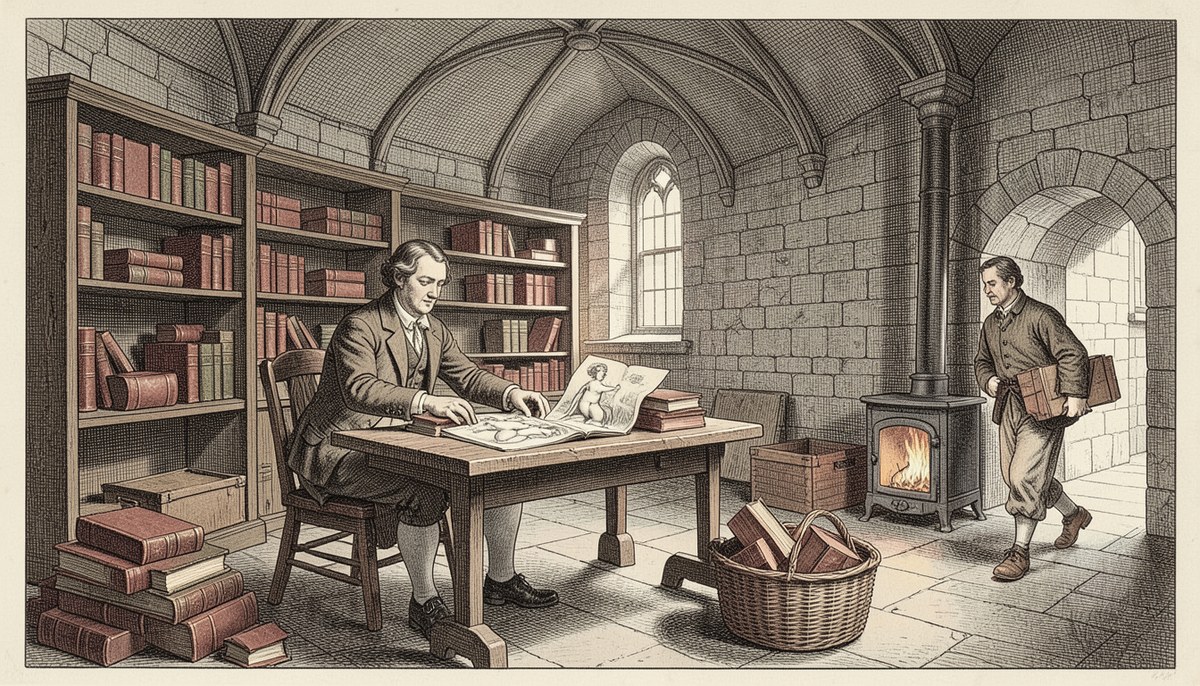
The Revolution begins by loosening the reins: censorship is abolished and trade guilds disappear in March 1791, including that of booksellers. Under the arcades of the Palais-Égalité, the most risqué prints and novels even serve to signal the prostitutes waiting for clients.
But the same period fills the deposits: what has been taken from convents, fleeing nobles, and the condemned is piled up there. A man from the house, Joseph Van Praet, comes to shop with a very keen eye, and he gets his hands on a few gems of the genre, including a Boccaccio adorned with risqué plates, an Aretino, and a Cleland.
In 1795, he also begins to isolate the treasures of the house, and this is how the Reserve is born. The licentious titles will one day keep these wonders company. With Napoleon, the tone changes: the Emperor does not want to hear about censorship, but he insists that obscene books no longer circulate and entrusts the task to the police.
In 1810, Pasquier, who heads the Paris police, stumbles upon a strange surprise: none of what has been seized has been burned. The books sleep on a floor of his offices and an inspector distributes them to his friends, when he is not secretly reselling them. Pasquier solves the problem in his own way, with a large fire lit in the courtyard that burns for three hours. Nothing is saved for the Library.
1844: Hell finally receives its name
For a long time, people have said all sorts of things about the birth date of the Inferno. Apollinaire traced it back to Bonaparte, while Pascal Pia pushed it to the twilight of Napoleon III's reign: both were wrong.
The true baptism took place in 1844, when librarian Paulin Richard reviewed the old catalog numbers and wrote a note in the margin, next to the series of novels: "Inferno." The word must have pleased him, as it soon appeared elsewhere in the catalog. Even before this baptism, the collection already included about 150 books.
What is surprising is the timing. It was during the reign of Louis-Philippe, at a time when the government was rather liberal, and it was not the government that wanted the Inferno: it was the institution that decided it on its own. There is a social logic here: the book now reaches the working classes, and the institution is merely setting aside what society already condemns.
The Inferno quickly made headlines. A few years later, a rumor claimed that two-thirds of the Inferno had been stolen. It was mainly a maneuver to distract from another scandal, the Libri affair: there were indeed thefts, but they were far fewer in number.
Seizures, customs and bequests: how the collection was filled
One might think that the Library purchased these books, but it's almost the opposite. Until 1876, the Hell (L'Enfer) gathered around 620 titles, and just over half of these titles came straight from the police.
Under the Second Empire, the administrator Taschereau goes even further: he wants everything that customs officers seize at the border and everything that the post fails to deliver. The result is immediate, as more than 300 volumes arrive in two years. Purchases, on the other hand, are very rare. When a licentious book enters through a purchase, it is almost always because it was part of a large library bought in bulk.
Donations are rare as well, but one of them is quite touching: a Marseillais, Hubaud, bequeaths his books to the Library to keep them safe, as in the hands of a too-scrupulous private individual, they risk being destroyed.
By the end of the century, serious publishers take hold of the genre. They republish the old classics, but in limited editions and out of commerce, and it is at this price that these reissues are tolerated. The legal deposit contributes a part. And Hell (L'Enfer) grows even larger at the beginning of the 20th century.
The Bégis Affair: the stripped collector who fed Hell
The heart of Hell owes much to a man who never accepted it. Alfred Bégis wears several hats. His profession is that of a bankruptcy trustee. He is also a lawyer, he dabbles in history in his spare time, and above all, he collects: he has thousands of books and he is on the hunt for everything Sade wrote by hand. In 1866, two packages intended for him fall into the hands of the police. The police were looking for something else, pamphlets from abroad, but they are not disappointed.
The rest resembles a novel. They search his home and leave with several hundred items, where books and engravings are intertwined. The judge then gives him a cruel choice: he must either renounce his position or allow his collection to be destroyed. Bégis keeps his position.
However, nothing is destroyed. Everything goes to the Imperial Library, where they take care to register it... as a gift! His lawyer will say it is theft committed with a knife to the throat.
Bégis fights for thirty years, and he eventually sues the Library in the 1890s. He loses. For Hell, the case is a windfall: over 160 books enter at once, along with lots of engravings that include some of the finest titles of libertinism.
Codes and records: bringing order to Hell
When Delisle took over the house, he found that the old classification by subjects no longer worked and preferred alphabetical order. L'Enfer (The Hell) followed suit: new numbers were assigned taking into account the size of the volumes, and it was the books that arrived after 1876 that topped the list.
This detail has misled historians. Pascal Pia was mistaken. For him, number 1 was the very first piece of the collection, whereas it was merely the first book entered after the change in method. The lesson still holds for those conducting research: a classification number tells the story of an arrangement, it does not necessarily tell the story of a collection.
The cards, on the other hand, are the work of a certain William Viennot. And in 1896, Delisle ultimately wrote down in black and white what everyone already knew: L'Enfer is a "collection of obscene books."
Who had the right to open the door?
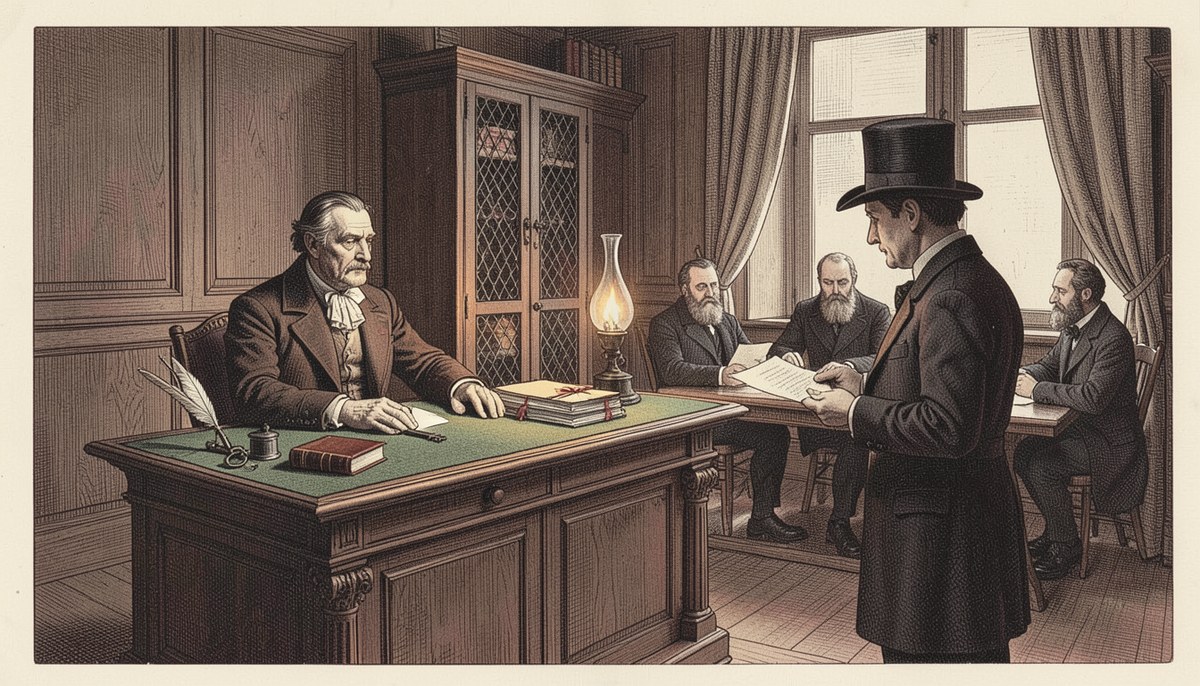
In theory, almost no one had the right to enter. The key to Hell remains in the pocket of the curators, and the reader who wants to see a book from Hell must first write to the general administrator to explain why they want this book, and they must do so very carefully. A small committee of curators then reads the request, and the answer is very rarely yes.
Bégis, who had good reasons to be bitter, did not care: for him, all these formalities served only to ensure nothing was obtained. Apollinaire and his two friends would have been better received than others.
The system, however, had its flaws. A frankly daring poem, La Légende des sexes (The Legend of the Sexes), ended up classified among everyday poetry. Its author, Haraucourt, was very upset about this. The result was that anyone could read it without asking anyone for permission, and it took until 1965 for a copy of this book to pass through the other side of the door.
Apollinaire, Perceau and Fleuret: the first real catalog
Around 1909, Apollinaire gets to work. The poet enlists two accomplices, Perceau and Fleuret, in a somewhat crazy project: the goal is to describe everything, from the first to the last volume.
Their work is published in 1913 under a lengthy name, an "icono-bio-bibliography." Behind this scholarly term, one should simply understand a catalog of all of Hell: for the first time, the entire collection is reviewed from start to finish.
In the same year that the project begins, Apollinaire also defends a writer he admires. He considers Sade to be the freest of spirits, and he believes that this brand new century could very well be his. Given the place Sade has taken among writers, one might think he was not entirely wrong.
The books that made the reputation of the Hell
There are titles that come up in every conversation among enthusiasts. The oldest is the Ragionamenti of Aretino, dating from 1534: the author indulges in dedicating the first dialogue to his monkey. Two centuries later, a future censor publishes a satire of the Regent under a tricky title, since it is enough to mix the letters of Apprius to find Priapus.
The enthusiasts all dream of Thérèse philosophe. It is one of the most sought-after libertine novels of the 18th century. Its heroine is about 25 years old when she discovers pleasure, and it is books and painting that serve as her teachers. Originally, the book circulated with 16 engravings. Later, Cazin, a publisher who has been imprisoned twice in the Bastille without changing his profession, produced a nice version with images by Borel.
The absentees are equally telling: Diderot, for example, has never received this treatment. In his Bijoux indiscrets, the most daring pages are written in languages other than French, which perhaps explains why he was spared, and his Religieuse has never received an infamous rating. This did not prevent the film that Rivette made from being banned, before being released the following year.
Point de lendemain (No Tomorrow), by Denon, experienced the opposite fate: the original story never entered it, while its rewritten version, much more libertine, found its place.
Sade, the most present author... and the least read
No writer occupies as much space in Hell as Sade. It’s a strange paradox: everyone knows his name, but very few people have actually read him. His major work, the Nouvelle Justine (Justine) followed by Juliette, consists of several thousand pages and a hundred engravings, enough to discourage even the bravest.
The man himself ended his life imprisoned, as he would not leave after his arrest in 1801. His books, however, continued to circulate in secret, and a critic of the July Monarchy amused himself by seeing them in all the libraries, always on a shelf that was carefully hidden.
The 20th century changed the game. Breton and his surrealist friends read him passionately, while scholars meticulously established his texts.
In the aftermath of the war, Pauvert took a huge risk by signing his name to the complete edition, and he paid for it with nine years spent before the judges. Free sale was allowed in 1958, at least on paper, as it would take another good ten years for it to become a reality.
Engravings: the art of "covered" and "uncovered"
On the image side, Hell retains the trace of a engraver's trick that is good to know. The same plate can exist in two versions: in the first, the characters are naked, in the second, a drapery has come to dress them. Specialists speak of "nude" state and "covered" state, or before and after the veil. The process is not new: it spreads from the 16th century and reaches its golden age in the 18th.
How does the engraver go about it? He first pulls a few nude proofs, then he takes back his copper plate to add the fabrics. There is another, simpler method: a small piece of engraved paper is glued onto the proof to hide what needs to be hidden, and the copper is left untouched. For an amateur, what to remember is simple: the nude state, printed in a few copies, is the rarest, and a cover can be recognized by its paper glued over the image.
These images have a long history behind them: they descend from the great masters of the Italian Renaissance and their famous Loves of the Gods. With Mellan, a woman first shown naked receives in a second state a small leaf of vine, a gesture that recalls the nudes that were veiled during the time of the Counter-Reformation.
Later, architect Lequeu offers the Library a series of lascivious drawings, which are locked away as soon as they arrive. And in 1868, a police raid makes connoisseurs smile: on one of the seized images, Dumas père, already in his sixties, is recognized alongside Adah Menken.
From the key to the showcase: what Hell says about censorship
One day, Hell emerged from its hiding place to show itself to everyone. It was the Bibliothèque nationale de France itself that had the idea to open its doors for a grand exhibition. The visitor traveled from Sade to 20th-century authors, seeing along the way pornographic photographs and prints from Japan, and ended his visit on secrecy and reading.
Should we see this as a victory for transparency? For some observers, showing Hell is also a way to make it harmless: the forbidden fruit becomes a museum object. Others remind us that books and hell have always had one thing in common, fire: when censorship believes itself too weak, it often ends up lighting a pyre, like Pasquier in his courtyard.
What the history of this collection tells us is primarily about the evolution of perspective: what one era hid, the next reissues, comments on, or exposes. To keep the essentials in mind:
- Hell was born under Louis-Philippe based on a purely moral criterion
- it was mainly filled thanks to seizures
- to access it, one needed a written request and the agreement of a committee
- Apollinaire and his friends created the first complete catalog
- its covered or uncovered prints tell the story of modesty
The next time an old volume announces an impression in Cythera, take a second look: it may come from a world where these pages were read behind closed doors.