
A genre long cursed, now rediscovered
For decades, erotic comics have occupied a strange place: widely read, highly sold, yet absent from visible shelves, bibliographies, and exhibitions. Newsagents placed them high up, large retailers refused to distribute them, and booksellers feared administrative commissions. The result: a whole part of the history of the ninth art has aged in boxes, in the hands of patient collectors.
This corpus has long been treated as a sub-production. However, it is enough to reconstruct the chronology to reveal a coherent editorial history, with its pioneers, its publishing houses, its national graphic schools, and its breaks. Italy and its pocket industry, France with Losfeld and then Glénat, post-Franco Spain: none of this is anecdotal.
The work of cataloging and reissuing carried out since the 2000s has shifted the lines. Authors, publishers, and especially booksellers have finally unearthed these albums from oblivion, realizing one simple thing: the feared censors, probably fearing ridicule, did not manifest. One can legitimately wonder if this long purgatory was really necessary.
1949-1954 : when censors strike everywhere
The story begins with a legal lock. The Liberation had given rise to a multitude of illustrated magazines and a true wind of freedom, but the law of July 16, 1949 - brought to France by an improbable alliance between Catholics and Communists - makes comic books a children's affair, thus a domain where almost everything is forbidden.
The effects are very concrete, almost comical in retrospect. Skirts are lengthened, breasts are toned down, weapons are banned: it is not uncommon to see a panel where a character threatens their enemy with an empty hand, the revolver having been erased from the original edition. In Belgium, to avoid French censorship, some publishers simply prohibit their artists from featuring women in their stories.
On the other side of the Atlantic, the mechanism is the same, with a face: that of psychiatrist Fredric Wertham. In Seduction of the Innocent, he denounces comic book heroes, violence, sex, and his fight leads to the establishment of the Comics Code Authority by Congress in October 1954. Some publishers abandon comics, while others comply with the code.
The pin-ups of 1940s comics - Sheena, Torchy and their counterparts - disappear in the wake. To speak of a golden age for the 1950s is therefore a misunderstanding: for the lover of illustrated eroticism, it is mainly the golden age of censorship.
The 1960s: Barbarella breaks the ground
The real kickoff dates back to 1962, when V Magazine, a quarterly mixing humor, photos and erotic stories, publishes in episodes the voluptuous Barbarella by Jean-Claude Forest. The prepublication goes almost unnoticed. It is the album, released in 1964 by Éric Losfeld, that triggers the scandal: quickly banned by censorship, the object becomes famous while its sales remain limited, and the heroine will be the first comic book character taken up by Le Livre de Poche.
Losfeld perseveres with "Les Aventures de Jodelle" by Peellaert and Bartier, "Saga de Xam" by Nicolas Devil, "Lone Sloane" by Druillet... before abandoning comic books due to lack of success. He had paved the way. In 1969, Charlie Mensuel becomes the first magazine to openly cater to adults, with Georges Wolinski as editor-in-chief, and Georges Pichard introduces his Paulette there.
In Italy, the revolution is industrial: adult pockets flood the market. As early as 1962, Diabolik, then Kriminal, Satanik, Demoniak, Sadik, Zakimort mix bloody crimes and intimate sequences. From the mid-sixties come the heroines - Isabella, Jolanka, Vartan, Uranella, Messaline - who cross the Alps at the end of the decade under the watchful eye of French censorship.
In the United States, on the West Coast, a generation confronts the Comics Code with underground "comix": drugs, sex, anti-militarism, farewell to superheroes. Crumb, Shelton, Spain Rodriguez will arrive in France through the magazine Actuel, but their penetration will remain marginal in the Hexagon.
The 1980s, the editorial golden age
The seventies had blown everything apart: Pilote, Circus, Charlie Mensuel, (À Suivre), Métal Hurlant, Fluide Glacial published steamy scenes without being rated X, and even Spirou and Tintin admitted sexy heroines, previously banned. Meanwhile, Elvifrance flooded newsstands with about twenty monthly publications in 1978, importing the best of Italian production.
In the face of this popular comic book scene, some publishers chose a more refined approach. Dominique Leroy published Philippe Cavell, Georges Pichard, Gérard Leclaire, G. Lévis. Jacques Glénat, a young publisher from Grenoble, allowed Pichard to sign his first work as a complete author. Guido Crepax was translated by Albin Michel, Futuropolis and Le Square, and his sometimes hermetic eroticism reached a wider audience with his adaptations of "Histoire d'O" and "Emmanuelle".
In 1979, Jean Carton, previously a publisher of erotic novels, launched the monthly Bédé Adult', where Lévis, Nan, Ange, Cléo, Miss Bondie and many others began their careers. This was followed by Bédé X, SexBulles, Love Bédé, albums under the CAP or Sedem labels. And in 1982, L'Écho des Savanes, taken over by Albin Michel, turned without hesitation towards eroticism, revealing Massimo Rotundo, Magnus and especially Milo Manara.
The result: until the mid-eighties, in newsstands, bookstores and even supermarkets, adult comics occupied an increasingly prominent place. This was indeed the most prosperous period for the genre.
Georges Pichard, the complete author of the genre
If one name summarizes the French trajectory, it is his. Georges Pichard first published in Le Rire, drew "Ulysse" with his accomplice screenwriter Jacques Lob, then created the voluptuous Paulette in the pages of Charlie Mensuel, at a time when this magazine claimed its adult readership.
His decisive move took place at Glénat, where he created his first work as a complete author: Marie-Gabrielle de Saint-Eutrope. Writing and drawing alone, in a genre where the script was often commissioned in bulk, changes the nature of erotic storytelling - it shifts from a mere food pamphlet to a signed work, with its own graphic and narrative logic.
This status did not protect him: "Marie-Gabrielle en Orient" had to be withdrawn from sale, like a few other albums of the genre. Pichard also works for Dominique Leroy, in this vein of publishers close to the Losfeld spirit who bet on a more constructed eroticism than that found in kiosks.
Proof of his place in the history of the genre: when Glénat and its subsidiary Drugstore reissued their great classics in the 2000s, "Marie-Gabrielle de Saint-Eutrope" topped the list, alongside Manara, Varenne, Paul Gillon or Trillo and Bernet.
Milo Manara, a safe bet
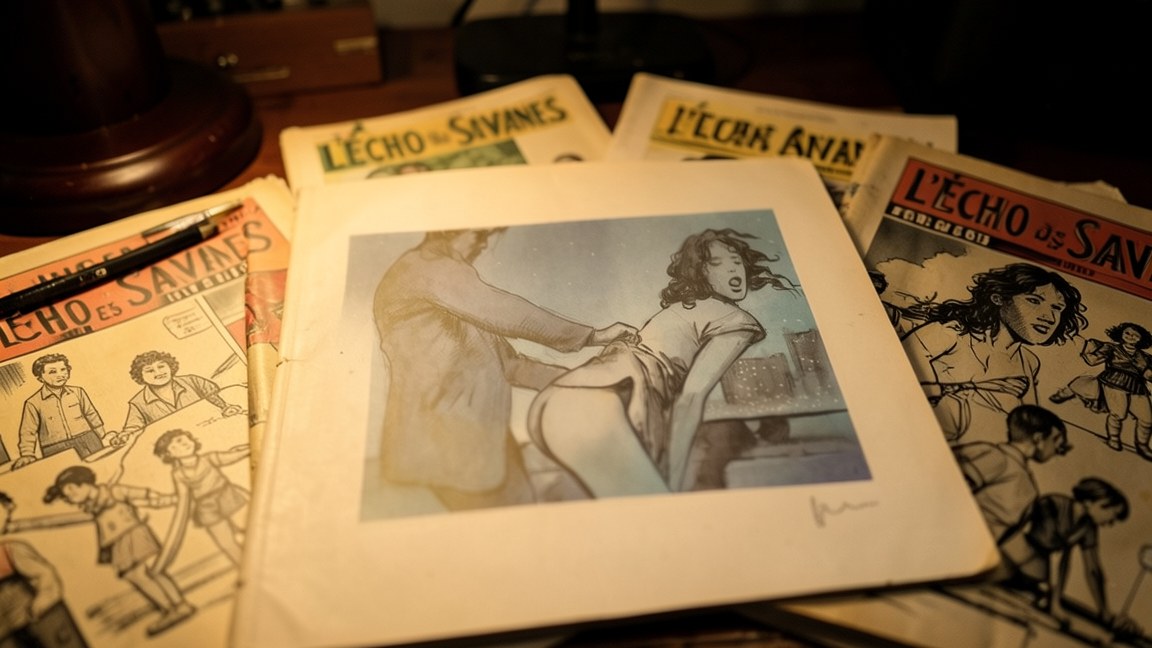
Manara belongs to that generation of Italians trained in the popular circuit - he worked for the publications of Renzo Barbieri, the man behind adult pockets - before becoming a recognized name on both sides of the Alps.
His arrival in France comes through L'Écho des Savanes, Albin Michel's version, starting in 1982. With Rotundo and Magnus, he opens the doors of adult comics to a new readership, less popular and more bookstore-oriented than that of the kiosk pamphlets. The contrast is stark: on one side, tens of thousands of pocket buyers, on the other, an audience that buys an album for its artwork.
In the 1990s, when everything collapses around him, he remains the only pillar of the catalog: Albin Michel stagnates, with Manara as its only sure value. And when Glénat and Drugstore revive the classics, it is Le Déclic and Le Parfum de l'invisible (the latter in color) that return to the forefront.
In other words: Manara is the bridge. He makes acceptable in bookstores what the kiosk distributed under the suspicious gaze of censors.
Erich von Gôtha, Janice and the tradition of the submission narrative
The story of submission did not originate in Europe. As early as 1946, the American magazine Bizarre created Sweet Gwendoline, a young woman subjected to refined tortures: bondage was born. In the early fifties, Irving Klaw's Nutrix launched specialized magazines, featuring a team of artists - Eneg, Eric Stanton, Jim, Mario, Antonio Ruiz.
This genre survived thanks to very strict house rules imposed by the publisher to circumvent censorship, which are worth detailing:
- only women appear throughout the pages, never fully nude,
- blood never flows,
- the genitals remain invisible,
- the abuses must not target intimate areas, nor breasts, nor the lower abdomen.
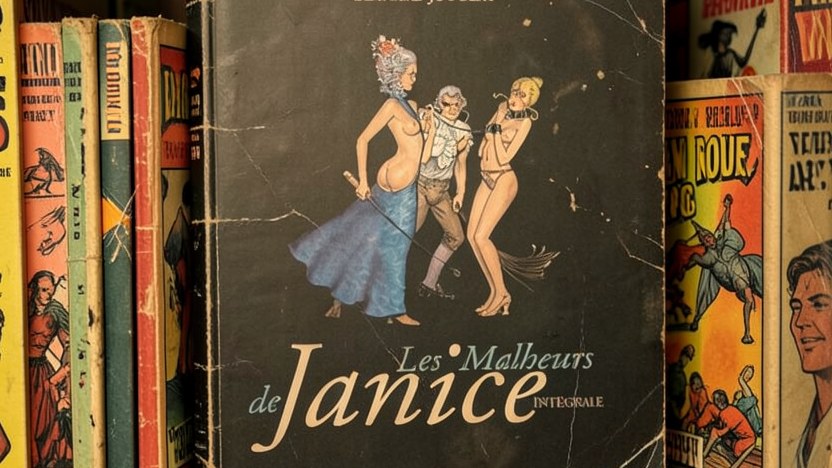
In Europe, it wasn't until the seventies that a few masters of bondage emerged, published notably by Humanoïdes Associés and Dominique Leroy. It is in this lineage that Erich von Gôtha fits, whose Janice - Les Malheurs de Janice - and Twenty are among the emblematic stories of the genre in France.
His albums are featured in the catalog of Dynamite, the comic book department of éditions la Musardine, directed by Christian Marmonnier after being run by Bernard Joubert. Von Gôtha shares space with Roberto Baldazzini, Giovanna Casotto, Igor, Noé, or Kevin Taylor: a Franco-Italian-Spanish-American catalog, with a polished presentation, supported by an efficient mail-order service.
Media 1000: illustrated eroticism in pocket format
When the Italian pockets disappear from kiosks, a French publisher takes over the small format: Média 1000, with its BD Adultes collection, dedicated to stories by French authors. A strategic choice, counter to a market that had imported most of its production for twenty years.
The flagship title is launched in 1994: Erotic Confessions Comics. The principle is simple and ruthlessly effective: no fixed character, but the visualization of stories sent in by female readers (and sometimes male readers), with titles that reveal the theme - "I was the toy of a perverse couple", "Abandoned by my husband", "My husband filmed our lovemaking with a camcorder". These stories also had a press version.
The illustrator who establishes himself is Ardem, the pseudonym of Alain Mounier, already known to readers of Circus and Dargaud. From the second volume, he becomes his own writer, the sole master on board: fine lines, carefully crafted close-ups, realistic sequences without being sordid, and above all, a staging that constantly varies the settings and situations - like a camera that must move to avoid monotony.
Chris, the pseudonym of the Spaniard Xavier Musquera, also illustrates the series of "Interdits" (Forbidden) and then "Confessions érotiques" starting in 1995. Média 1000 also gives a second life to albums: the three adventures of Doctor Sex signed by Arcor, initially published by CAP, are reissued in pocket edition.
Italy, Spain, United States: a transnational history
Italy is the driving force. From 1962 to 1992, fumetti per adulti dominate a market where the classic comic book has remained marginal, with hundreds of titles released each month. Renzo Barbieri, a screenwriter turned publisher, founded Editrice 66 in 1966, then Edifumetto in 1972: Isabella, Goldrake, Angelica, Biancaneve, Sexy Favole, Zora, Sukia, Lando... and covers by Alessandro Biffignandi, stunning and eye-catching. These popular magazines feature prominent names: Leone Frollo, Magnus, Sandro Angiolini, Stelio Fenzo, Milo Manara.
Spain, free from Franco, seeks new idols. Several magazines emerge, including El Vibora, which discusses drugs, marginality, and sex, rejects any form of censorship, and sees the rise of an entire generation of young illustrators. The publisher of the title, La Cupula, then innovates with Kiss Comix, a monthly entirely dedicated to hard comics, successfully blending humor and love. In France, it becomes La Poudre aux Rêves in 1998 for legal reasons.
In the United States, Fantagraphics Books creates the Eros Comix brand: original works, reprints of classics, translations of European series. Playboy and especially Penthouse have their comic book versions, the latter directed by George Caragonne and translated throughout Europe, where former illustrators like Dan Barry, Gray Morrow, Richard Corben, or John Burns work alongside young authors.
As for Japan, it operates according to its own rules: magazines of several hundred pages, capable of all sorts of boldness, where only the representation of male genitalia and body hair remains prohibited until the late nineties. French translation attempts remain largely confidential for a long time.
The 1990s: censorship tightens its grip
The law of 1949 has never disappeared, it has simply relaxed in its interpretation, which has not prevented the banning of many titles for adults. The champion of administrative troubles is Elvifrance: 747 bans, including 36 of level 3, in twenty-two years of existence.
Nota Bene - the three levels of bans. The mechanism deserves to be understood, as it explains everything else:
- level 1: ban on sale to minors,
- level 2: adds a ban on display, thus the disappearance of the window and the display stand,
- level 3: ban on advertising, which delivers a commercial blow to a title.
In the eyes of a commission that knows only one type of comic book, that intended for children, any adult album is suspect. Barbarella experienced this as early as 1964, "Marie-Gabrielle en Orient" by Pichard as well, and the manga "Video Girl Ai" from Tonkam is still banned from sale in 1996. In 1988, Charles Pasqua, then Minister of the Interior, even invited the press to an exhibition of horror where the banned comics were prominently featured.
Last tightening: the entire publishing chain producing a work becomes responsible for censorship issues. Hence the absence of erotic comics in large stores and train stations, where no seller wants to risk their job for an album.
1992: Elvifrance closes, the kiosks empty out
The increasingly intense censorship leads Elvifrance to close its doors in 1992. In just a few weeks, about twenty titles disappear from newsstands. And, curiously, no one seeks to take this place. That same year, in Italy, Edifumetto abandons comics and shifts to real estate: the golden age of fumetti per adulti comes to an end on both sides of the Alps.
Bédé Adult' and Bédé X continue their publication, but the disappearance of the pockets does not boost their sales - quite the opposite. However, a new generation is emerging: Starzo, Topaz, Rocheret, Février, Kovak, Arès, Cornélius, Tarzis seem ready to take over in increasingly polished magazines.
The other pillars fall one after another. The Marquis collection, published by Glénat, stops appearing in 1996, as do the Dominique Leroy editions. Albin Michel stagnates. A few initiatives remain: the BD Adultes collection from Média 1000, the Sex in Italy collection launched in 1997 in the wake of the magazine Selen, which highlights young transalpins, and the arrival of Druuna by Serpieri, the only character from Bagheera editions.
The aftermath is a hemorrhage: La Poudre aux Rêves stops in 2004, Bédé Adult' and Bédé X throw in the towel the following year, leaving most stories unfinished. Many then blame video for capturing the popular readership. Only La Musardine, through its subsidiary BD Dynamite animated by Bernard Joubert, maintains regular publication.
The Awakening: erotic comics return to bookstores
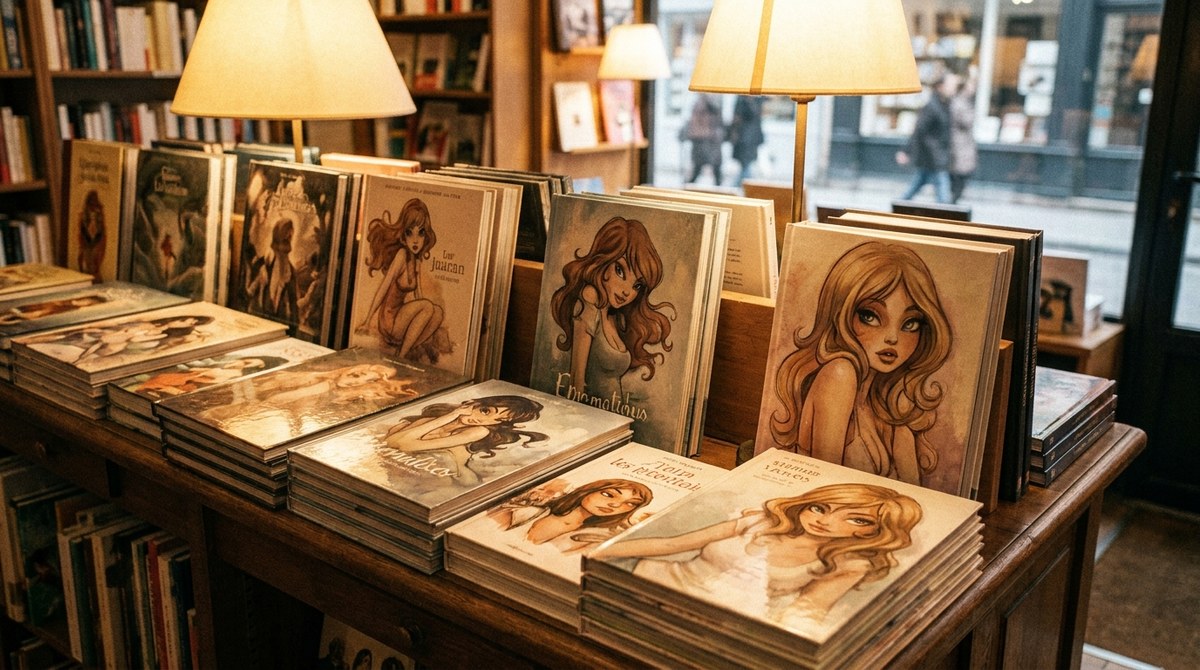
The turnaround begins in 2006, with authors from a generation that works with digital imagery. Arthur de Pins joins Fluide Glacial with his "Péchés mignons" (Little Sins): computer-generated artwork, characters with rounded shapes and large expressive eyes, immediate appeal. The first album, released the same year, is a success.
Delcourt sets the machine in motion. At the end of 2007, after much hesitation, the publisher translates Lost Girls, by Alan Moore and Melinda Gebbie - released without any censorship issues, contrary to predictions. This is followed by "Premières fois" (First Times) in April 2008, a collective work written by Sibylline with Alfred, Pedrosa, Vatine, Bertail, Capucine, Augustin, then Happy Sex by Zep, the first best-seller of the genre in a long time, and "Love blog" by Gally and Obion in 2010. In 2009, the Erotix collection is born, reissuing out-of-print classics: "Emmanuelle" by Crepax, "Casino" by Frollo, "Liz et Beth" (Liz and Beth) by Lévis, "Sam Bot" by Buzzelli, alongside creations like "Celluloid" by Dave McKean.
The movement becomes widespread. Drugstore publishes "Arthur et Janet" (Arthur and Janet) by Cornette and Karo in 2008, Glénat and Drugstore reissue works by Pichard, Manara, Varenne, Gillon, Trillo, and Bernet. Petit à Petit launches in 2009 large luxurious works adapting literature ("Grivois Tales by Maupassant", "Kâma Sûtra in Comics"). Fluide Glacial continues to release risqué albums and creates Fluide.G at the start of the 2010 school year. Tabou occupies the harder terrain with Xavier Duvet or Emmanuel Murzeau, the Requins Marteaux reconnect with the spirit of pockets through their BDcul collection, the Ange editions reissue Robert Hughes, and in 2011, La Musardine and Drugstore/Glénat adapt the Osez collection into comics.
The lesson from this chronology is quite clear: the genre has never lacked readers, it has lacked distribution. If you want to discover it, approach it from both ends - a reissue of a classic (Pichard, Crepax, Manara, Frollo) to understand where the style comes from, and a contemporary creation to see where it is going. And do not hesitate to ask for it at bookstores: it is still the best way to remind that adult comics have a rightful place on the shelves.