
Booklets without publisher or advertising
Let’s start by presenting them, as their name changes depending on where you are. Across the Atlantic, everyone chose at will between Tijuana bibles, dirty comics, and eight-pagers: no word has managed to impose itself everywhere.
Behind these labels lies the same object: a small pornographic comic produced and sold outside of any legality. No advertising or catalog, nothing that would allow them to be counted at the time they were sold.
Take one in hand and you will immediately see what it looks like: 8 pages in landscape format (hence the nickname eight-pagers) in black and white, a staple, and a slightly sturdier cover with one panel per page. With its dimensions of about 5 cm by 10 cm, the booklet also earned the nickname two-by-four.
Each issue tells a self-contained story: no ongoing serial. The manufacturers, however, liked to work in series of ten titles around a theme: gangsters, comic book heroes, Snow White, or Hollywood stars.
Why do we talk about Tijuana bibles?
The term that ultimately prevailed, Tijuana bibles, dates back only to the late 1940s. It refers to a Mexican city located just south of the border, where bars and brothels thrived thanks to prohibition.
Tradition has it that the very first copies were printed there, but there is no real proof of this, and it is better to keep the conditional when recounting this story.
To understand their emergence, one must primarily look at America in the 1930s: the economic crisis hit hard and prohibitions multiplied. It is in this context that a publisher whose name is unknown launched the first of these small booklets.
Note: diverting a comic strip to make it pornographic was not a new idea. Maggie and Jiggs were affected by this as early as the mid-1920s. The star couple of Bringing Up Father, created by George McManus, thus served as a guinea pig long before the crisis.
Who held the pencil?
None of these artists signed their work, as one might expect. Given the often low quality of the line work, one can easily imagine shadowy hacks without commissions in mainstream press, ready to accept this kind of work, but nothing confirms this portrayal.
One style, however, stands out clearly from the rest. Its nickname, Mr. Prolific, comes from historian Donald Gilmore: the term aptly describes the extent of his work, as he is credited with around 200 booklets. He is recognizable by his evident craftsmanship and the hatching that sculpts the bodies.
His identity remains a mystery, even if some have believed they uncovered it: it would be Doc Rankin, whose real name is Ainsworth Rankin, who made a living at a newspaper in Brooklyn. This idea is based solely on what Gershon Legman recounted, and it has never been confirmed.
In fact, only one author truly emerges from anonymity: Wesley Morse, whose own family has dispelled the doubt.
Publishers always on the run
Did those who financed these booklets all have gangster looks? Young Will Eisner encountered one who had the appearance: in the 1930s, this man with a mobster's demeanor offered him $4.50 per page, an offer Eisner declined before recounting the scene much later in The Dreamer.
The overall picture is, however, less romantic: most of these bosses were small entrepreneurs attracted by quick profits, much more than organized gangs (unlike what we saw with filmed porn).
Take the case of Abraham Rubin from Brooklyn. He was suspected of hiding under the name Al Stone. Under this signature appeared Fuller Brush Man, a dozen episodes dedicated to a traveling salesman. When questioned during a hearing, he invoked the 5th Amendment to say nothing.
The FBI primarily targeted wholesalers and manufacturers. Newspapers of that time reported huge seizures, sometimes reaching several million booklets. In terms of courts, those who accumulated offenses risked spending several years behind bars. Hence a nomadic life: to evade agents, these small bosses constantly moved their presses, from Cleveland to Milwaukee.
From the Barber to the Gas Station
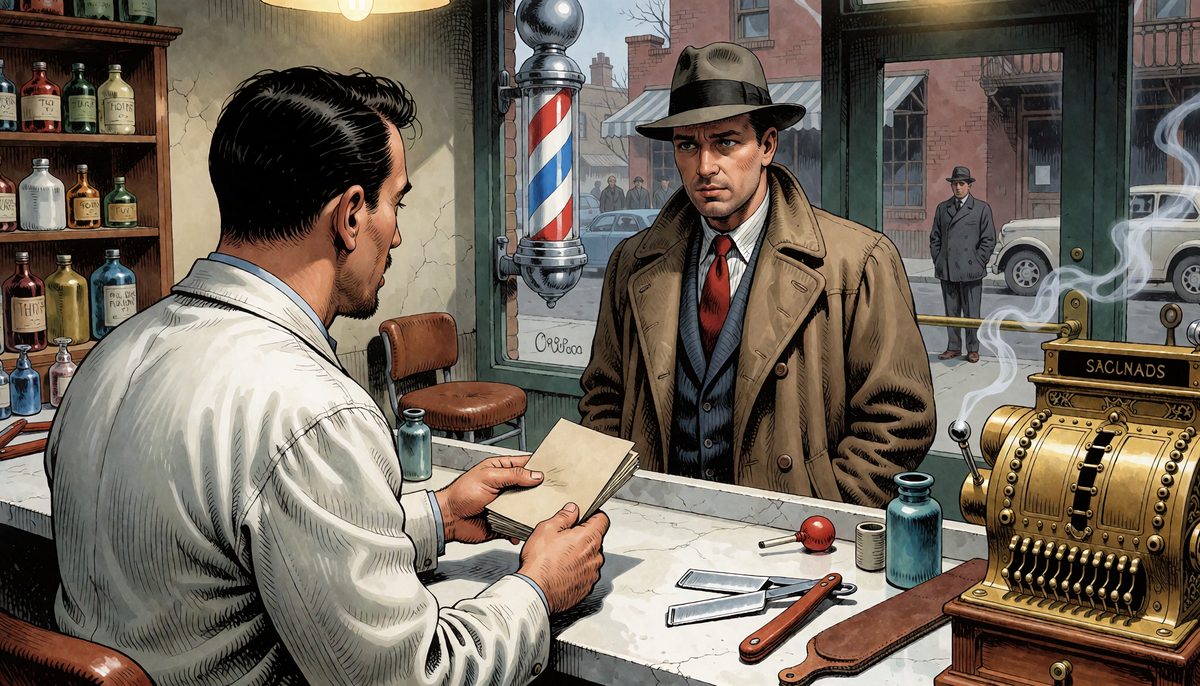
There is no need to look for these booklets in shop windows, as they were discreetly obtained at the counter of a bar, from the barber, or at the gas station, and it all depended on the region: here the police turned a blind eye, elsewhere they cracked down.
Do not be fooled by their modest appearance, as the quantities are staggering. A single title could reach 50,000 copies, and each outlet received a package of 100 from the wholesaler.
On the wallet side, the decline was rapid: around 1935, the enthusiast still shelled out several dollars for a single copy. By the end of the decade, the price had dropped to a maximum of 50 cents: a sum that remains substantial, as a Superman comic cost 10 cents.
Popeye, the number one target
If one had to designate a favorite victim, it would be Popeye. No mainstream character has been as parodied, and one can guess why: he was everywhere, his spinach evoked limitless strength, and his boorish manners fit well with the spirit of these stories, while Olive Oyl appears little.
Popeye burst onto the scene on January 19, 1929, and his career was just beginning. He arrived in a strip that Segar had been animating since 1919, Thimble Theatre. Fleischer brought him to animation as early as 1933: it may be through the screen more than through the newspaper that parodists got to know him (this is just a hypothesis).
The booklets also offered their own adventure to the old Poopdeck Pappy or to Olive, and they even organized a summit meeting with Mae West. Among the most delightful, a 1934 edition released in New York sends the sailor and his friend Wimpy on a trip to Paris, with a notable blunder right at the start: it reads Perface instead of préface!
Betty Boop, Mickey, Churchill: the gallery of victims
The rest of the cast resembles a who's who of American pop culture. Open a random collection and you will quickly come across a familiar face, whether it be Dick Tracy, Flash Gordon or Blondie. The stars of the big screen also make appearances, as do statesmen such as Churchill and Gandhi. The titles attributed to Mr. Prolific include, among others, Betty Boop, Popeye and even Hitler.
Betty Boop deserves a moment's attention: born at Fleischer in 1930, the little vamp only acquires a fully human silhouette later, borrowing her features from singer Helen Kane. From July 1934 to 1937, she even had her own daily strip.
Flesh, a 16-page booklet released around the middle of the decade, transforms her into a starlet facing a producer. The setting leans towards the strips that took place behind the scenes of cinema.
How to date a dirty comic?
These booklets almost never have a reliable date. With a bit of practice, however, you can date a copy using a few clues:
- Donald’s beak: if the duck has a long beak, that’s a good indicator. He only had this profile starting in 1934 and for about two years, which places the parody in the mid-1930s.
- The title: a booklet titled Of Mice and Women, an obvious nod to Steinbeck, could only have been released after 1937.
- The format: some switched to a vertical format with 16 pages as early as 1934, and the cover sometimes gained a second or third color.
- The clarity: with the war, inventing ceased and they settled for reprinting, often with poor reproduction.
Purists also enjoy pointing out the mistakes: on some pages, the mouse has five fingers on each hand, an heresy for anyone familiar with the model by Ub Iwerks, which stops at four.
These details matter, as Disney-related items interest collectors: in 2002, a booklet of 8 panels featuring Mickey and Minnie reached $500 on eBay.
What do the 1955 hearings reveal?
Researchers are fortunate to have a primary public document: in 1955, Senator Estes Kefauver, who was investigating juvenile delinquents, heard several witnesses. Dirty comics were not his priority, but the testimonies clearly show how the trafficking operated on a daily basis.
A stationery seller from Washington recounts his small business: he paid 6 cents for each booklet, sold it for 10, and sourced them from a certain Ike Dorfman in Baltimore. A 13-year-old high school student explains that he paid 20 cents and resold them for double, to the point of having placed about fifty in his school, while the bookseller he accuses denies everything and will not be troubled.
A mother also recounts her surprise at her 13-year-old son's overalls: she finds booklets with Jiggs and Ella Cinders that she initially takes for children's comics! That same year, a police officer from Los Angeles even misjudges the size when describing the object: two inches by three, according to him.
This investigation had already had a much more lasting effect: as early as 1954, it had prompted comic book publishers to impose their own censorship, the Comics Code.
The end of the clandestine
After the golden age of the 1930s, the decline is slow: the war puts an end to new releases and only old issues are reproduced, becoming less and less readable. The agony stretches until the early 1960s, and the tally is summed up in two figures: more than thirty years of life and about 1000 titles.
Elsewhere, it is the laws that change everything: when Scandinavia legalizes hard imagery in the mid-1960s, underground manufacturers lose their reason to exist. Why hide when the Swedish Private is displayed as early as 1965?
Explicit comics then make their way to bookstore shelves, and by 1968, the American underground seizes it with Robert Crumb, S. Clay Wilson, or Snatch Comics. Northern Europe is not left behind: a Dutch album by van den Boogaard is released in 1970, and Sweden as well as Germany also have their explicit stories. In France, it is Gotlib who takes the plunge in L'Écho des savanes, with issue 2 from October 1972.
And Japan? It is impossible to say with certainty if a hidden production preceded hentai. Apart remain the works that were never published, like those that Tom of Finland kept to himself for a long time starting in the 1940s.
In Brazil, the catecismos by Carlos Zéfiro
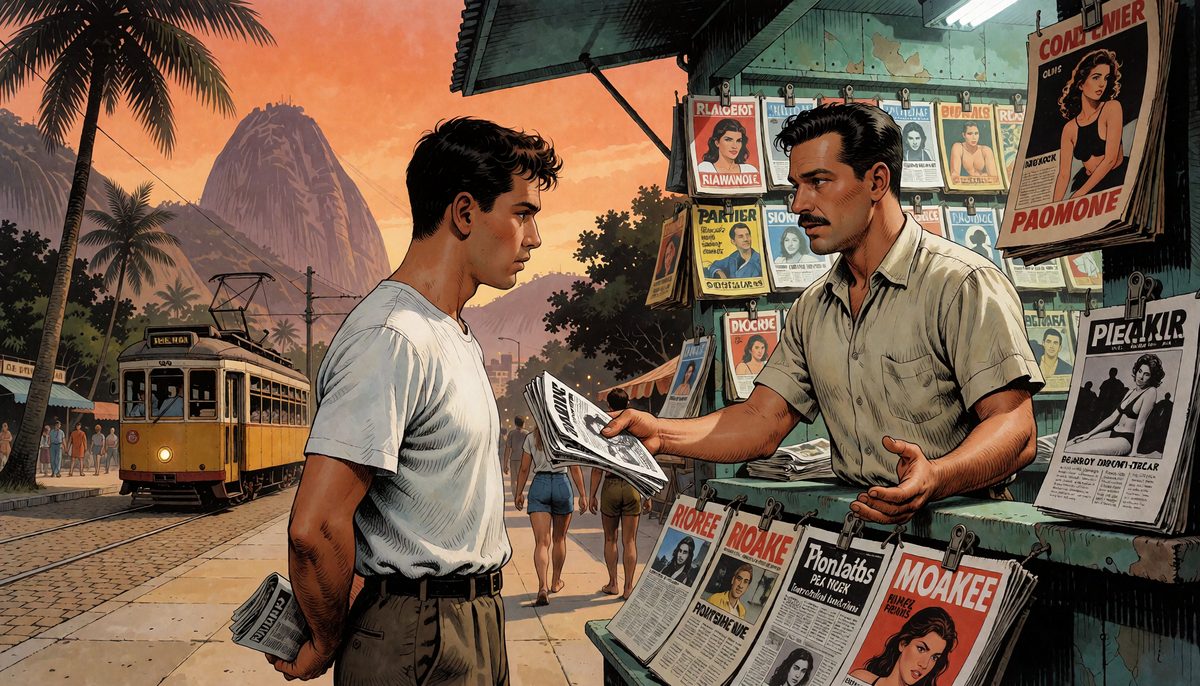
Let's change continents: in Brazil, booklets of the same kind had their heyday from the late 1950s until the early 1970s. They were nicknamed catecismos (the catechisms) with a good dose of irony.
To buy them, you had to ask under the counter at the newsagent or the men's barber. The object is a bit more generous than in the United States: A6 (10.5 x 14.8 cm) or sometimes A5, from 24 to 32 pages, almost always with a single panel per page. Expect 5,000 copies for a standard print run and up to 30,000 for the best. They also traveled through Portuguese-speaking Latin America.
One name remains attached to this little world: Carlos Zéfiro, behind whom was a certain Alcides de Aguiar Caminha. In civilian life, he was a well-organized carioca civil servant and fingerprint specialist, born on September 25, 1921, and father of five kids, who took out his pencils once the house was asleep.
His technique was clever: he traced photoromans and anatomical plates, allowing him to complete several stories in a week, while printing and sales were handled by the bookseller Hélio Brandão.
Zéfiro, from secrecy to recognition
He himself put the number of stories at 862, while collectors list around 500. Beware of fake Zéfiro, as they do indeed circulate.
Two blows ended this trade: the arrival of Scandinavian magazines and a police investigation that traced back to Brandão. Even in retirement, he prefers to remain silent: a text that punished the scandal could take away what he received from the State.
We had to wait until November 1991 for the mystery to dissipate in the pages of the local Playboy, after a colleague, Eduardo Barbosa, attempted to appropriate his stories. Everything escalates: the press praises him and Jô Soares invites him to his show. In 1992, the Troféu HQ Mix recognized him as a great master. He passed away just eleven days later (on July 5, 1992) at the age of 70, as if recognition had come just in time.
His death did not stop the tributes, quite the opposite: a cultural center in the Anchieta neighborhood of Rio honors his memory. Singer Marisa Monte invited him on the cover of one of her albums in 1996. The newspaper Extra had fun parodying him in 2009, and the theater dedicated a play to him in 2011.
Should we then cry genius? One might judge his talent limited and his plots repetitive, and think that nostalgia weighs heavily in his success. He rarely ventured into pastiche (Tarzan) or adaptation (Lady Chatterley), and the title that performed best remains Aventuras de João Cavalo.
France and Europe: portfolios rather than booklets
On this side of the Atlantic, erotic drawing before 1930 did not need to hide. Browse through Parisiana, Fantasio or Le Sourire: nudity is willingly displayed and allusions are present, but you will never see two bodies engaging in the act.
The following decade also does not see any clandestine booklets in France. Wealthy enthusiasts turn instead to expensive art portfolios produced in limited editions, like those by Rojan or Léon Courbouleix. There seems to be no known clandestine parody of the Famille Fenouillard.
During the 1940s, GIs landing in Europe do slip a few dirty comics into their luggage. Some enthusiasts have even found versions in European languages, but there is no evidence that they were produced locally.
Éric Losfeld later attempts a discreet venture in the late 1950s, with novels that feature speech bubbles but where one hesitates to see real comics. A little later, Histoires... appears, linked to the name of Pierre Delalu. It contains 50 full-page drawings, the work of a professional no one has been able to identify, and the whole may have come from the London district of Soho through Girodias. As for Docteur Black, released in Belgium in two colors, it probably first existed in Italian.
Meanwhile, Jean-Claude Forest dares a touch of sensuality as early as 1952, and it will take him another twelve years to launch Barbarella. Across the Channel, there is also a suspicion surrounding Norman Pett, the man who brought Jane to life in the British popular press: he is rumored to have created obscene drawings. Gérard Nordmann owned around sixty of them. Bound into a single volume, these sheets were auctioned at Christie's in 2006.
In France, censorship strikes openly
The oldest judgment found against a comic book dates back to December 1948. It targets the loves of a certain Lulu, a pin-up secretary by profession. The justice system sees it as an outrage to public morals and punishes both links in the chain, the one who published it and the one who printed it. A few months earlier, in May, Comic burlesque had been banned from the shelves.
The list then grows with Oh! in August 1950 and Romans en images (Novels in Pictures) in January 1954. The axe falls again in April 1956. This time, it strikes the Grands Romans noirs dessinés (Great Black Illustrated Novels). The couple who publishes them receives a suspended month and must pay 50,000 francs each. The two illustrators, Gai and Marculeta, must pay 15,000 and 20,000 francs.
In 1951, the place Beauvau (the Ministry of the Interior) silences Flash. Gwendoline had experienced a second life there, renamed Tendre Caroline (Tender Caroline). In the background, the law of July 16, 1949, on the press for youth also weighs on adult comics, and its commission is still in session.
Today, the game of hide-and-seek has changed opponents: the pirate parodies of Tintin, the Smurfs, or Suske and Wiske mainly fear the rights holders, rather than the police.
Collectors and reissues: how to discover these little illustrated works
These booklets attract today two types of enthusiasts: those of eroticism, of course, and those who hunt everything related to Disney. Mickey and his friends hold a prominent place in them, and the company has not taken kindly to this kind of tribute, as Dan O'Neill learned to his detriment. His two slim issues of Air Pirates Funnies released in 1971 forced him to battle for nine long years against Mickey's lawyers. The giant demanded up to $5,000 for each panel, while O'Neill argued fair use, the principle that tolerates certain borrowings. He also invoked the First Amendment, which did not prevent him from being sentenced to $190,000.
If the subject interests you, start with the reissues: Americans have been publishing them since the 1970s, and Donald Gilmore dedicated a story to them as early as 1971. Here, Transit gathered a selection in three albums as early as 1978, later reissued by Artefact and then by Allia. Beautiful books also have their place, with one from La Martinière in 2004. For the rest of this hidden heritage, one often has to settle for rare reprints.
And if you come across a period copy, take the time to examine it: format, print clarity, Donald's beak, all clues to date it. On the Brazilian side, keep in mind that fake Zéfiro circulate.
From Tijuana bibles to catecismos, this underground comic tells another story of the ninth art: that of pseudonyms, seizures, and twisted heroes. A story that remained hidden for a long time, which can finally be read with a clear face.