
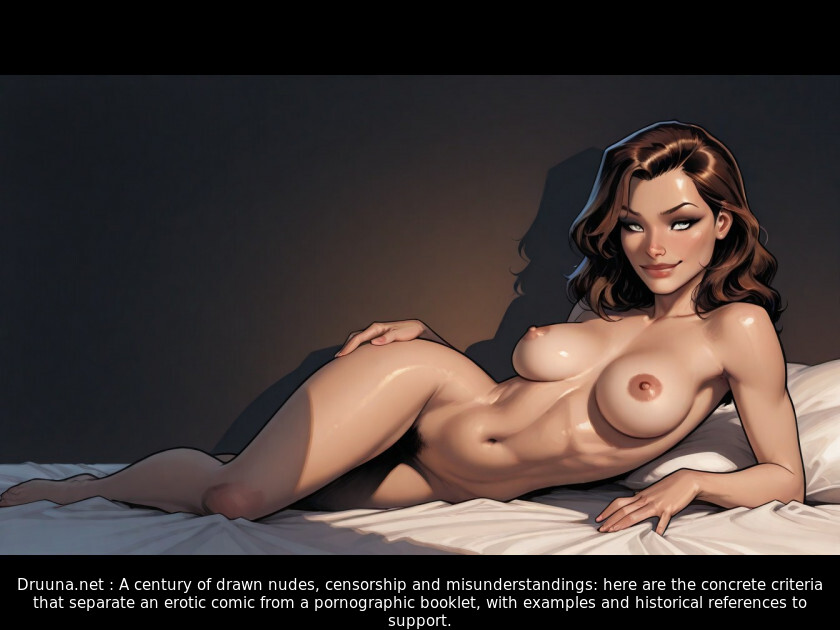
A century of suspicion: why the genre has such a bad reputation
Erotic comics were born practically at the same time as the first illustrated stories, nearly a century ago. And for a century, they have carried the same negative image, as if the mere act of drawing a naked body was enough to disqualify a page.
It must be said that the ground was mined. Even after the war, comics for youth were considered a sub-product intended for less bright children. When the medium itself is despised, attacking its adult version becomes an easy, almost gratuitous exercise.
The result is well known: sold under the counter, banned upon its appearance in bookstores during the sixties, exposed to the press as a piece of horror museum art by a Minister of the Interior in need of inspiration in 1988, and still "forgotten" in works dedicated to the study of the 9th Art. Many authors have taken to signing under another name when working for mainstream publishers, in order not to alienate morally concerned readers: Angelo Di Marco becomes Arcor, Alain Mounier becomes Ardem.
The irony of the matter is that this ghetto has never corresponded to the numbers. Several tens of thousands of readers have bought Elvifrance's pockets without ever admitting it, and Pichard, Manara, Varenne, or Serpieri sell more than some established stars of comics. The trial against the genre is moral, not aesthetic: that is precisely why we must pose the question of artistic limits with criteria, and not with modesty.
Censorship and concealment: the genre condemned to hide
The pivotal date is July 16, 1949. Driven by a witch hunt led jointly by communists and Catholics, the law of this date relegates comic books to a sub-literature for retarded children, to which everything is forbidden.
The effects are disarmingly trivial. Skirts that are too short are lengthened, breasts that are too visible are "trimmed," weapons are banned to the point that it is not uncommon to see a character threatening their enemy with their hand, their revolver having been erased from the original edition. In Belgium, to avoid French censorship on export, some publishers simply prohibit their authors from including women in their stories.
Concrete cases reveal the arbitrariness. Barbarella, pre-published as early as 1962 in V Magazine, poses no problem, but the album proposed in 1964 by Éric Losfeld is quickly banned: the press gets excited, the heroine becomes famous, and the sales of the work remain limited. "Marie-Gabrielle en Orient" by Pichard, published by Glénat, will also have to be withdrawn from sale, and the endurance record belongs to Elvifrance, with 747 bans, including 36 level 3 bans in twenty-two years of existence.
Nota Bene: there are three levels of prohibition. Level 1 prohibits sales to minors, level 2 adds a ban on display in windows or shelves, and level 3 additionally prohibits any advertising, which delivers a commercial blow. For several years now, the entire chain that publishes a work is responsible for any censorship issues it may encounter. Hence the absence of erotic comics in supermarkets and train stations: no seller wants to risk their job, and the bookseller prefers to place these albums where they cannot be seen.
The American case: from very tame strips to clandestine Eight-Pagers
In the United States, comic book eroticism begins with the sensuality of the daily press. In the realistic strips of the thirties, heroes are accompanied by dream creatures: Prince Valiant is courting the blonde Aleta, Flash Gordon travels through space alongside the glamorous Dale Arden, Mandrake has the spicy Narda as his companion, Secret Agent X9 encounters voluptuous adventurers, Tarzan discovers woman with Jane.
These girls have a sensuality that is palpable, but eroticism remains within the limits permitted by the dailies that publish them. Aimed at an adult readership, these stories do not provoke any revolution across the Atlantic. In Europe, and particularly in France where it is still believed that comic books are reserved for children, they are perceived as an offense to public morals. Add to this the discontent of French artists in the face of this serious competition, and you understand the ferocity of post-war censorship: unwittingly, American comics have largely contributed to the drafting of the 1949 law.
And in the meantime, the American economic depression gives birth to the "Eight-Pagers". These are small booklets of eight pages, printed on poor quality paper, which offer pornographic stories created by obscure hacks. The process is always the same: comic book heroes, movie stars, or political figures are borrowed and placed in scandalous situations.
Distributed underground, these booklets are a hit in a conservative America and continue their run until the sixties. Publishers and printers outsmart the police with numerous relocations and manage to publish hundreds of titles, which today delight collectors. The rest is known: the Cold War, the campaigns of psychiatrist Fredric Wertham and his book Seduction of the Innocent, followed by the establishment of the Comics Code Authority by Congress in October 1954, with the same effects on American comic books as the 1949 law had on us.
Dirty Comics: how to recognize the shift into pornography
The Eight-Pagers were renamed "Dirty Comics," undoubtedly to emphasize their questionable pornographic nature. The nickname is actually an excellent criterion: what shifts here is not the degree of nudity, but the disappearance of everything that makes a comic book. No proper narrative, characters borrowed from others, artwork produced on an assembly line, no signature, a single objective.
The comparison with American bondage from the same era is enlightening. In 1946, the magazine Bizarre created Sweet Gwendoline, and by the early fifties, Irving Klaw's Nutrix launched specialized magazines. To circumvent censorship, the publisher imposed very strict rules:
- only women appear throughout the pages, never fully naked
- blood never flows
- genitals remain invisible
- the abuses must not target intimate areas, nor breasts, nor the lower abdomen
These rules may seem absurd, but they produced a style. Forced to suggest, the artists gathered around Eneg, Eric Stanton, Jim, Mario, and Antonio Ruiz invented a grammar of posture, framing, and off-screen, strong enough for Stanton to publish the adventures of Blunder Broad until the mid-nineties.
The other sign of the shift is the forward rush. In Italy, when the pockets pushed the limits of what could be published to their maximum, publishers had to neglect stories with recurring heroines in favor of narratives without fixed characters, bloodier or more sadistic. Remember this mechanism: when the escalation begins, the character disappears, and with them, fiction. It is here, very concretely, that eroticism ceases to be a writing style and becomes a mere catalog.
Japan: everything is allowed, except for one anatomical detail

Japan, the land of prints, could not remain on the sidelines. Driven by several publishers like Mujin or Fujimi Comics, titles are multiplying, each theme having its own magazine, with a clear preference for nymphets entangled with older males.
These magazines contain several hundred pages and are capable of all sorts of audacity: torture, mutilation, multiple perversions. One thing was prohibited until the end of the nineties, the depiction of male genitals and body hair. This is a particularly variable geometry censorship, allowing the most graphic violence while stopping at an anatomical detail. A tasty detail: the European reader long had the privilege of discovering the author's original page before the genitals were erased for the Japanese edition.
In terms of reception, nothing compares to Europe. Sexy covers adorn the windows of newsstands, where erotic mangas are displayed without any problem, and titles aimed at teenagers, like Beat, are often as daring as our own X-rated series. Dozens of illustrators, including Haruka Inui, U-Jin, Yoshimasa Watanabe, Hiroyuki Utatane, or Yutaka Tanaka, produce material of great graphic richness.
And it is also from Japan that the most useful counter-example for our question comes. "Futari ecchi", published since 1997 in Young Animal and known here under the title "Step up love story", details the daily life and intimacy of a young couple, Makoto, a premature ejaculator, and Yura, very measured about the matter. Everything is explicit, sometimes in the form of instructive tables, but the sequences are laid back and breathe a candid love rather than brutality: the publisher claims it is a learning manual more than yet another erotic manga. With over sixteen million volumes sold in the archipelago and about thirty volumes translated here, the demonstration is made that explicit does not mean pornographic.
Western modesty, Japanese tolerance: two ways to draw the line
Compare the two situations and you will see that the boundary is not in the same place depending on the culture. In the West, and particularly in France, we continue to think as if all comic books were intended for children. It is this premise that produced the law of 1949, the commissions that still give their opinions, and the ban in 1996 of the manga "Video Girl Ai" from Tonkam.
In Japan, the logic is reversed. The image of the body belongs to a long tradition, erotic magazines are displayed at kiosks without causing scandal, and the prohibition focuses on a specific point of representation. We are very far from our Western modesty, in a country where mentalities are decidedly different from ours.
On the market side, the gap comes at a cost. In France, several publishers have attempted to translate these typically Japanese products, from Samouraï to Albin Michel, passing through Le Téméraire and Bédé X, but distribution has remained limited. Italy, Spain, and the United States have shown much more interest in these exotic and violent stories, to the point that Spanish magazines have long filled their pages with material from Japan.
The last symptom, and it serves as a lesson: some European artists have gone so far as to create fake mangas, to flatter fans of these stories with youthful heroines. The boundary being discussed is therefore never just moral or artistic, it is also commercial. A genre that imitates a code instead of embodying it mechanically distances itself from creation.
Pichard, Manara, Varenne, Serpieri: when the taboo does not hinder the work
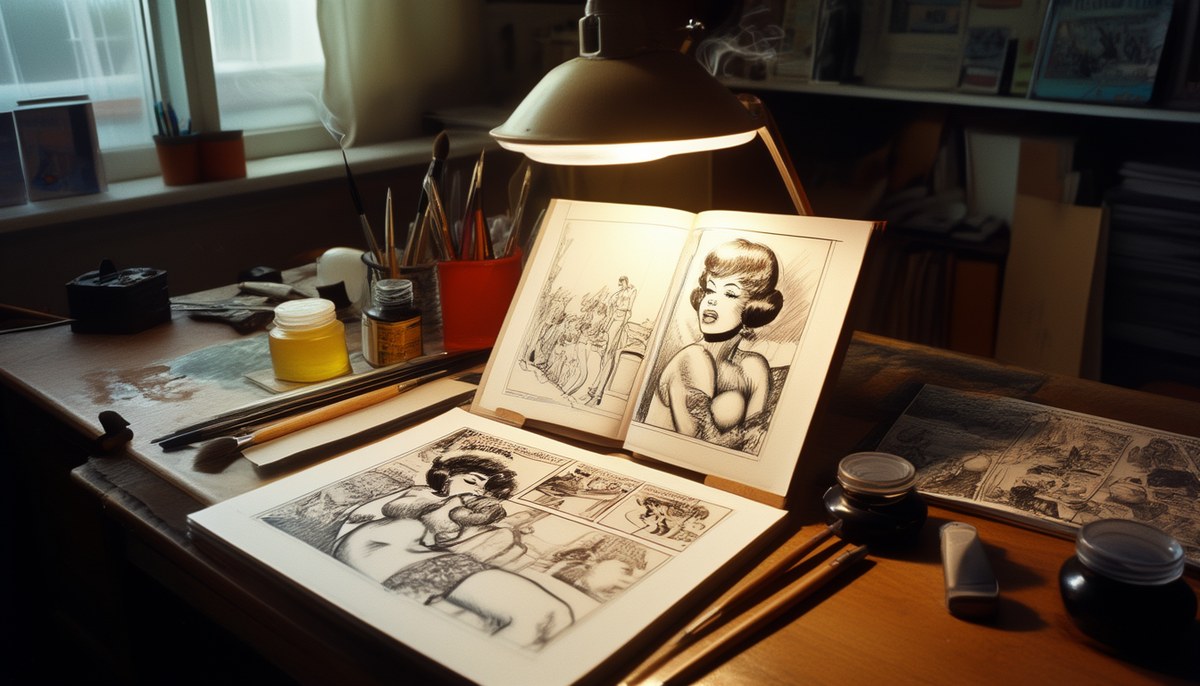
The most interesting aspect is that the genre has produced major authors while it was being pushed into the background. Georges Pichard first published in Le Rire, drew "Ulysse" with his accomplice Jacques Lob, created the voluptuous Paulette in Charlie Mensuel, this monthly magazine launched in 1969 that was the first to openly brand itself as "for adults" under the editorial leadership of Georges Wolinski, before signing with Jacques Glénat for his first complete author work, "Marie-Gabrielle de Saint-Eutrope".
Milo Manara owes much to L'Écho des Savanes, taken over by Albin Michel in 1982: the magazine then unhesitatingly turned to eroticism and opened the doors of adult comics to a new readership, with albums like "Le Déclic" or "Le Parfum de l'invisible". Guido Crepax, translated in France by Albin Michel, Futuropolis and Le Square, starts from an often hermetic eroticism and reaches a broader audience with his adaptations of "Histoire d'O" and "Emmanuelle". Alex Varenne, for his part, remained faithful to the genre even in its leanest years, and Paolo Serpieri established Druuna as the sole character of Bagheera editions.
What connects them all is the staging, and the term is not decorative. Ardem, in the "Confessions érotiques" of Média 1000, works with fine lines, takes care of his close-ups, offers hot and realistic sequences without ever falling into the sordid, and above all, having become his own screenwriter, he evolves his characters in unusual situations: the principle is that of cinema, the camera must constantly move to avoid monotony. With Philippe Bertrand, featuring Linda born in Pilote in 1983, it is the extreme refinement of the images, the beauty of the colors, and the charm of the characters that create a delicate eroticism.
The clearest criterion perhaps comes from Ricardo Barreiro and Francisco Solano López. Their series published in El Vibora and then in Kiss Comix aligns onanism, flagellation, torture, all the ingredients of sadomasochism, and yet it never falls into vulgarity, because the murky atmosphere, the construction of the narrative, and the psychology of the characters hold the page. That is the limit: it is not measured by the number of bodies, but by what has been written and drawn around it.
Video, the competitor that has emptied the newsstands
The 1990s were marked by a series of hard blows. Censorship became increasingly intense, Elvifrance closed its doors in 1992, and about twenty titles disappeared from newsstands in just a few weeks. Curiously, no one sought to take this place, and the sales of Bédé Adult' and Bédé X were not boosted by the disappearance of the pockets, quite the opposite.
In Italy, the same collapse occurred. Publishers had tried everything, larger formats, photos of naked girls as a bonus, but it was too late: in 1992, Edifumetto abandoned comics and became a real estate company. One might wonder what these readers suddenly turned to, and the answer is two letters followed by a medium: X video.
The list of closures in France is long. The Marquis collection at Glénat ceased in 1996, as did the Dominique Leroy editions, while Albin Michel stagnated with Manara as its only sure value. La Poudre aux Rêves, the French version of Kiss Comix since 1998, stopped in 2004, then Bédé Adult' and Bédé X threw in the towel in 2005, leaving most stories unfinished. BD Adult' returned in April 2006 at LVP Productions, with a curious presentation and a ridiculously reduced format, not really ideal for comics.
And this is precisely where the angle makes perfect sense. Video captured the niche of immediate excitement, the one where comics were anyway the least effective. It retained what filmed images do not: the line, the framing, the narrative. The launch of Selen in Italy in 1994 proved this, with a team of beginners inspired by Liberatore and Saudelli who carefully crafted their stories. It was no longer sub-comics, but constructed works, and the success was immediate among a trendy readership, very different from that of the pockets of the 1970s, until the title's cessation in 2003.
Waking Up: A Generation Without Complexes and Publishers No Longer Afraid
The impetus first came from a stubborn publisher. Thanks to its subsidiary Dynamite, led by Bernard Joubert and then directed by Christian Marmonnier, La Musardine consistently maintained the publication of well-crafted risqué works, supported by an efficient mail-order sales system, welcoming French, Italian, Spanish, and American creators: Roberto Baldazzini with "Casa HowHard" and "Beba", Giovanna Casotto, Igor and his "Chambre 121", Noé, Erich von Götha with "Janice" and "Twenty", and Kevin Taylor.
Starting in 2006, the arrival of a generation working in the virtual realm changed the game. Arthur de Pins joined Fluide Glacial with his "Péchés mignons", digitally drawn, with characters rounded and large expressive eyes, and the first album of 2006 met with immediate success. By the end of 2007, Delcourt translated "Lost Girls" by Alan Moore and Melinda Gebbie and, contrary to the predictions of naysayers, the work was marketed without any censorship issues. This was followed by "Premières fois", a collective orchestrated by Sibylline in April 2008 featuring Alfred, Pedrosa, Vatine, Bertail, Capucine, and Augustin, then "Happy Sex" by Zep, the first best-seller of the genre in many years, and "Love Blog" by Gally and Obion in 2010.
The movement quickly expanded. Delcourt created the Erotix collection in 2009, which reissued out-of-print classics, "Emmanuelle" by Crepax, "Casino" by Frollo, "Liz et Beth" by G. Lévis, "Sam Bot" by Buzzelli, "Gwendoline" by Willie, alongside new creations like "Celluloid" by Dave McKean. The Petit à Petit editions launched in 2009 large luxurious volumes of nearly two hundred pages adapting our literature, with "Erotic Poems from French Literature", "Ribald Tales by Maupassant", and "Kâma Sûtra in Comics". Fluide Glacial multiplied risqué albums, from "Madame désire ?" by Grégory Mardon to "Linda Glamouze" by Camille Burger, before launching in the fall of 2010 Fluide.G, a quarterly intended to be chic and shocking but not shocking, featuring Anne Rouquette, Dupuy and Berbérian, Margaux Mottin, Véronique Cazot, Madeleine Martin, Sybilline, and Arthur de Pins. Add Tabou with Xavier Duvet and Emmanuel Murzeau, the Ange editions reissuing Robert Hughes, the Requins Marteaux reconnecting with the spirit of pockets in their BDcul collection with Morgan Navarro, Aude Picault, or Hubert Micol, and the Osez collection adapted into comics in 2011 by Tonia Savage, Eve E, Aya, and Karo.
So remember the markers, they are simple and can be verified page by page. A creative eroticism is recognized by a character that exists outside the scene, by a staging that varies its angles instead of aligning, by a line and color that carry an intention, by a capacity to address sadomasochism, desire, or intimacy without falling into vulgarity. The pornographic shift, on the other hand, is read in the excess, in the disappearance of the narrative and the hero, in the anonymous drawing done on an assembly line. The creators from the web have confirmed this in their own way, from Aurélia Aurita recounting her intimacy with rawness and tenderness to Pénélope Bagieu, Diglee, or Leslie Plée.
The future no longer really depends on censors, who mainly fear ridicule. It depends on booksellers, who must overcome their fear and accept to sell all forms of comics, and on you: ask for these titles, browse through them, compare a page by Manara, a page by Crepax, and an anonymous pamphlet from the thirties. In ten minutes, the artistic boundary will become much clearer than in any debate.