
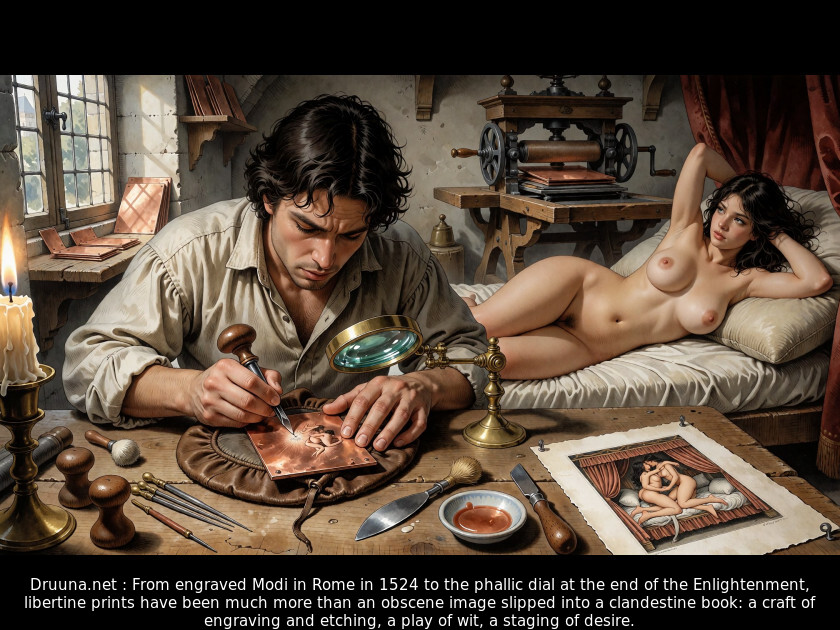
Libertine engraving and text: two expressions born together in the 16th century
The origin of libertine engraving and erotic prints is located in Rome, in 1524: that year, a friend of Titian engraved and distributed a series of twenty prints, the Modi (The Postures), where the gods simply make love. These plates, drawn by Giulio Romano and engraved by Marc-Antoine Raimondi, open a story where image and fiction will advance side by side for nearly three centuries.
The text arrives almost immediately. Between 1525 and 1527, Venice sees the publication of the Sonetti lussuriosi by Aretino, which place sonnets alongside the engravings... and any mythological allusion disappears. The gods give way to mortals, the scholarly pretext fades away.
It would be false to imagine two parallel stories, one of texts on one side and one of images on the other. Erotic engraving and licentious literature are born together at the beginning of the 16th century, constantly intertwining, then exhausting themselves together at the end of the 18th century and in the very early years of the 19th century (with the Restoration, another story of eroticism begins).
In the meantime, the series of engravings that extend the Modi, gathered under the generic title Amours des dieux (Loves of the Gods), have established a voyeuristic gaze that simultaneously celebrates the absolute of Beauty and the affirmation of pleasure. A sacred reconciled with the desiring flesh, in sum.
L'Arétin, ancestor of free engraving: a war machine against order
The Aretin and his Postures had a considerable influence on European engraving: the "Aretinian figures", these free engravings born in Italy during the Cinquecento, spread throughout Europe, and their trade never ceased from the beginning of the 16th century until the French Revolution. The founding gesture of the Aretin is a provocation: to pour deliberately obscene content into the sonnet, the poetic form most marked by Petrarchan tradition.
The extent of the phenomenon can be seen in a few testimonies. Brantôme mentions husbands who practice with their wives, in their own bed, "these enormous figures of the Aretin". Around 1638, Abraham Bosse engraves The Gallery of the Palace, where a bookseller's shop displays as a novelty, alongside the Works of Boccaccio, the "Postures of the Aretin".
The greatest names have carried on this tradition: Jules Romain, Titian and Raphael at the start, then Jacopo Caraglio, Perino del Vaga, Giulio di Antonio Bonasone, Augustin Carrache, the Primatice, Aldegrever, Beham, Pierre de Jode the Elder. A modern inventory lists about 40,000 pieces, and this is probably only a small part of what existed, since many engravings were destroyed after the Council of Trent.
In the 18th century, the Aretinian legacy changes scale. Text and image combined, libertine literature becomes a formidable "war machine" against the established order (this was already true of the Aretin, but now fiction and the provocation of the image come together). A sign that the wound is not healed, the poet Louis Doissin laments again in 1753, in his poem The Engraving, that Raimondi has put his "chaste burin" at the service of the Modi.
A simple illustration? Libertine engraving, a complete piece of fiction
Libertine engraving is not a simple illustration: it is a work in its own right, a piece inserted into a fictional device, and not the visual replica of the text it accompanies. From the Sonetti lussuriosi, the face-to-face encounter between the sonnets of Arétin and the engravings of Raimondi did not bring together two similar registers, and this asymmetry between image and text has been maintained until the Enlightenment.
To be convinced of this, one only needs to observe what the image does in a book. In the original edition of Thérèse philosophe (Thérèse the Philosopher), published in 1748, the last engraving does not illustrate any moment of the action: it refers to the collection of paintings that the count brings from Paris, along with his gallant library, to put Thérèse to the test, and its composition is inspired by the Loves of the Gods. The image comments, it does not copy.
In the 17th century, the interplay between text and image is mainly conveyed through humor. The collection Énigme joyeuse pour les bons esprits (Joyful Riddle for Good Minds), around 1620, shows the exact mechanism:
- ten placards, each composed of a carved figure showing a mundane scene from everyday life
- beneath the image, a first-person sonnet that implicitly asks the question "Who am I?"
- the image nudges towards an innocent answer, the text imposes a manifest sexual meaning
- on top of that, a parody: the placards faithfully copy a Parisian series from around 1613 praising the virtuous occupations of noble ladies, but with scabrous sonnets largely borrowed from the French translation of Straparole's Nuits facétieuses (Facetious Nights)
Le Centre de l'amour (The Center of Love), in 1680, proceeds in the same way: small genre scenes taken from two collections from 1624 by the German Peter Rollos, associated with brief French poems with crude images. But the encounter remains episodic at that time (even in the French edition of L'Académie des dames (The Academy of Ladies), the illustrations are gathered after the dialogue), and one must wait until the 18th century for fiction and engraving to serve a single and same purpose.
The tableau setting: the lively and scandalous exhibition of eroticism
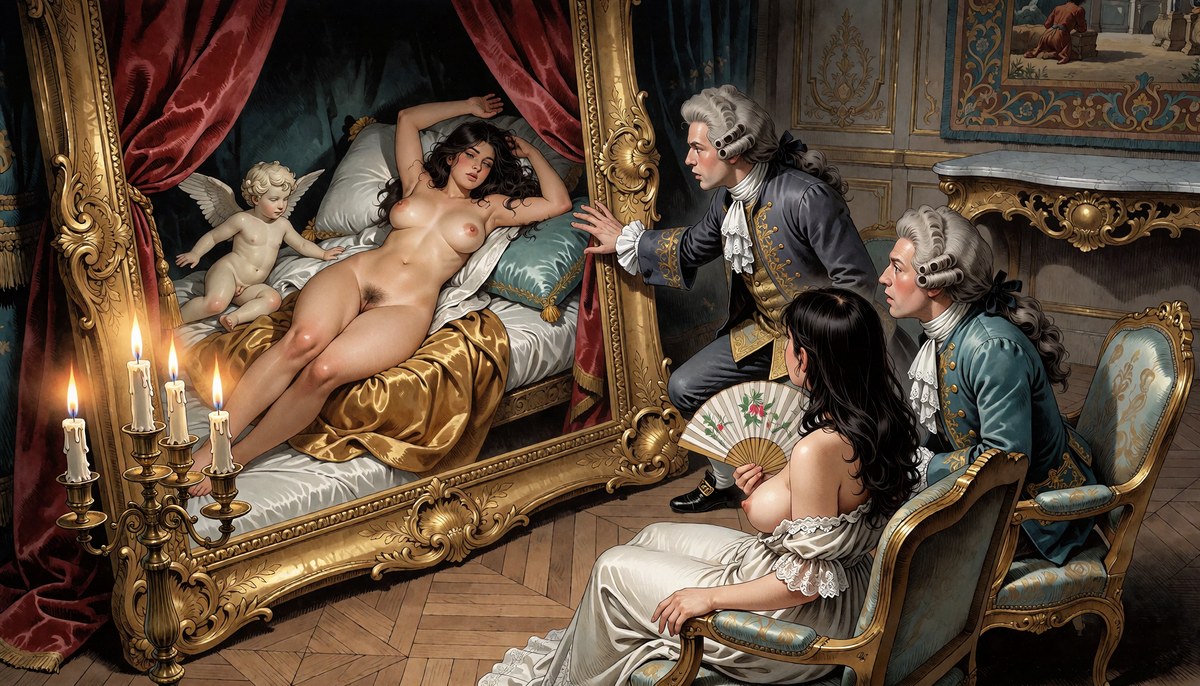
The erotic image is staged like a painting because libertine fiction relies on tableau: a vivid, striking, and scandalous exhibition of eroticism, where the reader is summoned as a spectator. To the tradition of The Loves of the Gods is added genre engraving, and the encounter of scenes from painting, especially that of the Regency, with the motifs of erotic engraving from the Renaissance produces a whole repertoire of situations that recur from one book to another.
Voyeurism is the most visible spring of this tableau. In the January 1741 edition of the History of Dom Bougre, an engraving shows a double scene: Suzon cannot take her eyes off what she discovers, while Saturnin observes what Suzon usually hides. In The Bells (1751 edition, adorned with four engravings while the 1749 edition had none), the hero's distress arises from the effect of reading on a young girl, to the point that the book falls from the reader's hands.
Thérèse Philosophe takes the principle to the extreme. The heroine only gives herself to the count after reading the novels from his gallant library and contemplating paintings like The Festivals of Priapus or The Loves of Mars and Venus. The painting does not decorate the narrative, it is the instrument of it.
Nota Bene: a hypotyposis is a description so vivid that it places the scene before the reader's eyes. In libertine fiction, the erotic hypotyposis of the text and the engraving work together, and this double register is one of the signatures of the genre.
Etching and engraving: what Abraham Bosse's treatise says about the engraver's craft
The techniques of etching and engraving are at the heart of the craft described by Abraham Bosse in De la manière de graver à l'eau-forte et au burin, a treatise later reissued by Cochin. Bosse, who dedicated several engravings to the representation of engravers' workshops, knew the workbench from the inside. For libertine prints, the decisive lesson lies in the format: when "small engraving" becomes widespread, that is to say, the illustration of books in-8°, in-12 or in-18, the engraver can no longer really go into detail and must settle, writes Cochin, "for a few small strokes artistically touched."
The two tools share the erotic plates. The burin is that of Raimondi for the Modi, the etching that of Augustin Carrache. One also encounters color-enhanced etchings, as for an edition of the Histoire de Dom Bougre (plates measuring 16.3 x 12.2 cm), or etchings reworked with a burin for a second printing with the caption, as for La Nouvelle Sapho. Claude Mellan, for his part, engraves La Femme à la souricière using drypoint and burin.
A particular know-how deserves attention: the "exposed" and "covered" states (also referred to as "before the veil" and "veiled"). Documented since the 16th century, the practice reaches its greatest development in the 18th century, according to a precise method:
- the engraver initially conceives a decent version, with draperies prepared in the composition but not yet incised
- he first pulls a few proofs from this first state, where the sex remains shown in a rudimentary but explicit manner
- he then incises the veil on the copper to obtain the covered state, while the few exposed proofs circulate through channels close to honorable circuits
- variant: affix a carefully engraved and cut paper mask onto the exposed proof, which keeps the copper intact to satisfy new demands
The Aretino by Agostino Carracci in 1798: erotic poses etched in etching
The Aretin by Augustin Carrache, published in 1798 by Pierre Didot under the fanciful address "To New Cytherea", brings together twenty plates of erotic postures executed in engraving by Jacques-Joseph Coiny (1761-1809) after the etchings by Augustin Carrache (1557-1602). The full title makes the intention clear: Collection of erotic postures after the etchings by this famous artist, with explanatory text on the subjects.
This is the most explicit lineage between the Renaissance and the end of the Enlightenment. Coiny engraves while looking at the prints attributed to Carrache, and his collection is the only testimony we have left of these original engravings. The subjects remain those of the Loves of the Gods: couples from mythology or ancient history.
The exact genealogy, however, remains debated. It has been suggested to link these plates to a series of the Loves of the Gods engraved in Antwerp by Pieter de Jode the Elder (1570-1634) after drawings by Carrache, but no plate by De Jode has survived to this day, and the hypothesis remains weak. What is established is that Coiny relies on anonymous Italian engravings, themselves copied from older prints that were associated with the Aretin since the second half of the 16th century.
The text, attributed to Simon-Célestin Croze-Magnan (1750-1818), recounts the amorous exploits of the characters and extends them with quotes from the "most famous erotic poets": Virgil, Ovid, Corneille, La Fontaine, Voltaire. The contrast is striking when flipping through the volume, the modesty of the comments responds to the license of the images.
Erotography or pornoscopy? The detours that make engraving a learned art
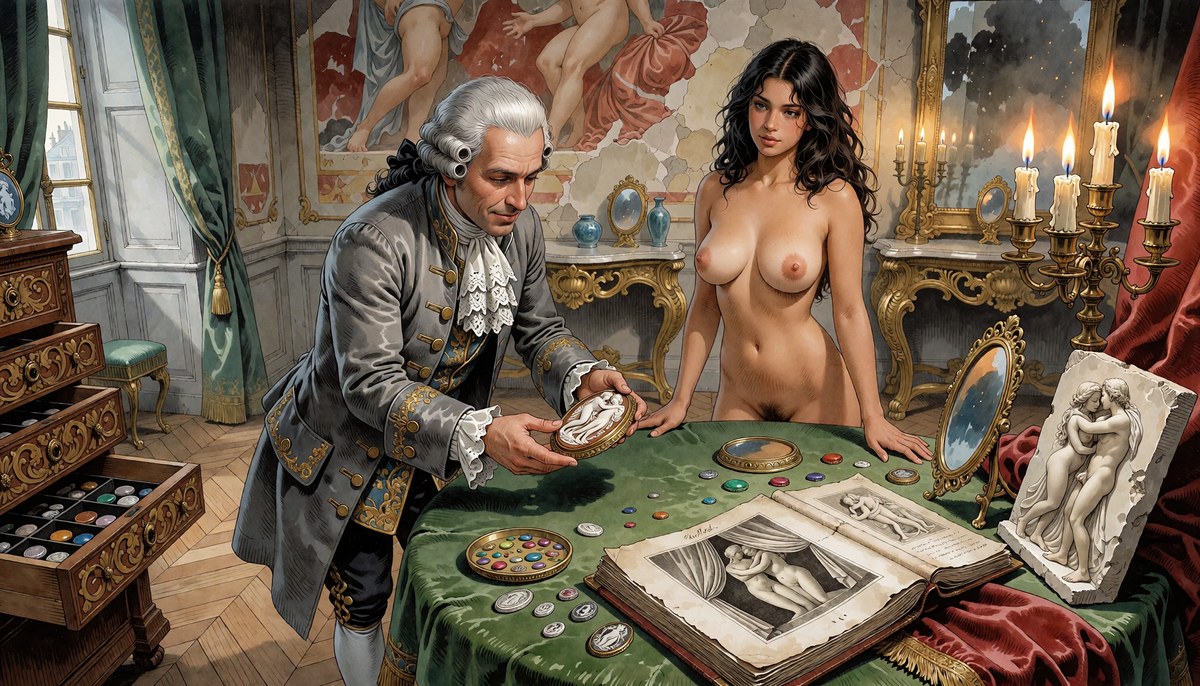
The difference between libertine eroticism and pornography in the 18th century lies in the detour: simple "pornoscopy" exposes coupling, while libertine "erotography" constructs a strategy of avoidance and encirclement around what it shows. Showing united bodies is not enough; cameos, intaglios, murals, and ancient bas-reliefs already did this to excess, and the Renaissance brought it to artistic perfection.
What changes is the relationship between eros and reason. For the Greeks, Eros was a cosmic force, "the first of the gods" according to Hesiod and Parmenides. Libertine eros becomes the subject of a reworking of its relationship with reason, in all tones: cunning, playfulness, cynicism, provocation, wit. The turning point occurs in the mid-17th century with L'École des filles (The School of Girls, 1655) and especially the Satyra sotadica by Nicolas Chorier (between 1659 and 1660), which marry the free examination of reason and the affirmation of pleasure.
How to distinguish, in front of a plate, the learned print from the simply obscene image? A few criteria emerge:
- it belongs to a device (narrative, legend, commentary) instead of standing alone
- it exploits the gap between what it shows and what the text says, like the modest comments of Croze-Magnan in front of Coiny's plates
- it navigates between allusion and obscenity, without falling into insignificance or mechanical repetition
- it engages knowledge: curiosity, learning, what has been called the "will to know" of desire
Desire wants to know, and what it wants to know, it also wants to show. However, it never shows it better than through the detours of language and seduction, which makes libertine representation a fluid art, almost sophistic, as unstable as the free agility of the mind.
Boucher, Fragonard, Eisen, Gravelot: the great names of libertine engraving
The artists who created libertine engravings in the 18th century are among the best talents of their time: Binet, Boucher, Cochin, Eisen, Elluin, Fragonard, Gravelot, Longueil, Le Mire, Marillier, among others. Just like in the Renaissance, a period steeped in sensuality and hedonism mobilized the finest pencils.
Gravelot's case sheds light on the behind-the-scenes. For an edition of the Decameron, he draws most of the one hundred and sixteen figures (some are signed by Boucher, Eisen, and Cochin), engraved mainly by Nicolas Le Mire. There are also unsigned free figures, twenty-one or twenty-seven depending on the counts, also by his hand. Gravelot reluctantly agrees to this, but he discusses the commission down to the last detail ("should the end of the tobacco appear?") and sets his price: no less than sixty francs per piece.
The most renowned duo remains that of the designer Borel and the engraver François-Roland Elluin, attached to the publisher Hubert-Martin Cazin (1724-1795), known for his carefully crafted small formats, who published numerous licentious works starting in 1773 (and earned two stays in the Bastille for it). Among their works:
- Thérèse philosophe, 1785 edition "enlarged with a greater number of figures than all previous ones"
- the New Translation of Woman of Pleasure or Fille de joie by Cleland (1776), with fifteen engravings
- L'Arétin françois (1787), seventeen engravings and a frontispiece imitated from the Loves of the Gods
- the Memoirs of Saturnin, twenty-four engravings that stand out from all other editions of Dom Bougre
Their strength lies in movement: nothing is static, the characters are captured in the midst of a gesture and the playful tone always surfaces. Eisen, for his part, provides the drawings for Félicia (1782): of the twenty-four engravings, thirteen belong to genre engraving and eleven are free.
Thérèse Philosophe and Dom Bougre: when anonymous engravers remain clumsy
The engravings of Thérèse Philosophe and Dom Bougre show the other face of the genre: in their original editions, the prints are the work of anonymous and somewhat untalented designers and engravers. These two clandestine classics have seen so many reissues that the quality of their images ranges from frankly mediocre to remarkable.
Thérèse Philosophe, published around 1748, features sixteen engravings that closely follow the narrative and were still in circulation until 1775. One detail reveals the haste: the sixteenth, Mars and Venus Surprised by Vulcan after Agostino Carracci, was replaced by Jupiter and Olympias, taken from the Modi. The History of Dom Bougre, published in January 1741 with a print run of between 1,400 and 1,500 copies, includes eighteen anonymous engravings, which the so-called Trotener edition reproduces almost identically, in a more refined manner.
The anonymous engravers work in clandestine workshops, and it shows: poor paper, printing errors, crude workmanship, as seen in the 1783 edition of the Memoirs of Suzon. Many even reuse the same prints for different texts, for better and especially for worse. The Cazin editions illustrated by Borel and Elluin are the perfect counterexample.
Should we conclude that the obscene drags the image down? No: there is no correlation between the obscene nature of a representation and its aesthetic quality. While the best libertine illustrators do not compete with the masters of the Renaissance, it is the production constraints that weigh heavily, first the clandestinity, then the small format.
The frontispiece of The Dial of Volupté (The Dial of Pleasure): a stopped clock to close the genre
The libertine engraving disappears after the Revolution because the genre exhausts itself from within: through repetition, its codes become rigid, and the anonymous frontispiece of the Cadran de la Volupté (The Dial of Pleasure) or the Aventures de Chérubin (The Adventures of Cherub) provides the most telling image. The subtle balance between showing and knowing is reduced to a simple and dense phallic symbol, a clock stopped at noon in history.
The book is a pamphlet from the revolutionary era: the queen experiences an adventure during a party organized by Cagliostro, with a page who will only reveal his identity at the Revolution. The graphic device is constructed with care:
- the false title is typographed in the shape of a dial, numbered from one to twenty-four
- the hours of pleasure unfold in the opposite direction of the clock's hands
- each hour has its dedication: manualism, embraces, fury, rest, titillations, languor, kisses, up to farewells
- the frontispiece reprises the dial, whose hand is a phallus
The idea is ingenious, but it marks the end of an era: the hand is doomed to turn mechanically on the dial of a pleasure imprisoned by its codes. The acceleration of production has ultimately turned repetition against itself, draining the principle.
At the same time, Sade's writing takes over with an entirely different power, and the Revolution abolishes censorship through Article 11 of the Declaration of the Rights of Man, while awaiting new censorships. With the Restoration begins another story of the erotic image. For those who collect or study these engravings, the Cadran serves as a milestone: a genre opened by the Modi in 1524 closes in on its own clock.